Comparison Guide
EIN vs SSN: What's the Difference? (2026)
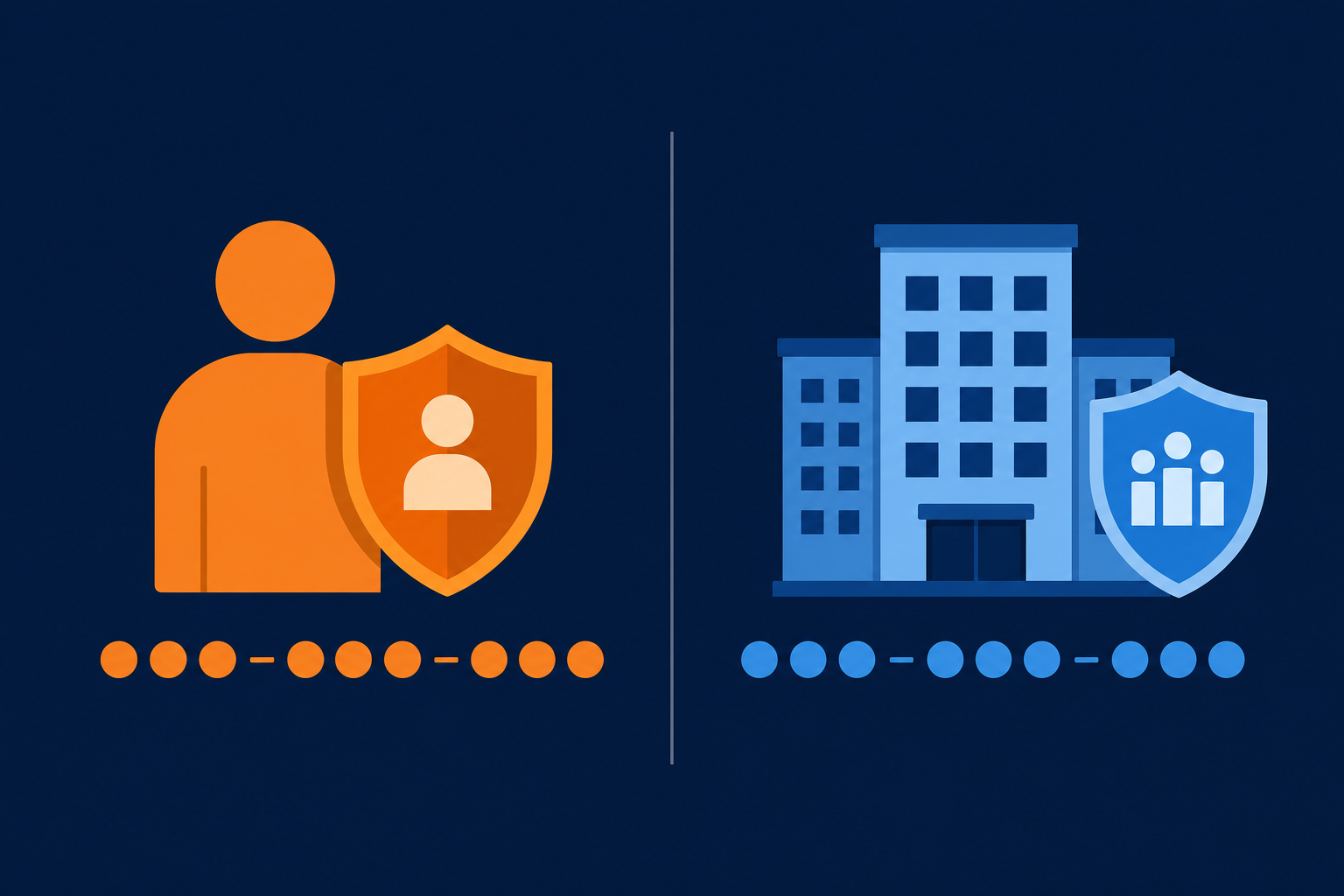
Both are 9-digit identification numbers issued by the US government, but they serve fundamentally different purposes. An EIN identifies your business. An SSN identifies you as an individual. Here is the complete comparison.
Subject to delay due to IRS processing time.
Last updated: September 7, 2026
Short Answer
How Do an EIN and an SSN Compare?
A side-by-side breakdown of every key difference between an EIN and an SSN.
| Feature | EIN | SSN |
|---|---|---|
| Full Name | Employer Identification Number | Social Security Number |
| Purpose | Identifies a business entity for tax and banking purposes | Identifies an individual for employment, taxes, and government benefits |
| Who Gets It | LLCs, corporations, partnerships, sole proprietors, trusts, estates, nonprofits | US citizens, permanent residents, and authorized work-visa holders |
| Format | XX-XXXXXXX (e.g., 12-3456789) | XXX-XX-XXXX (e.g., 123-45-6789) |
| Digits | 9 digits | 9 digits |
| Issued By | IRS (Internal Revenue Service) | SSA (Social Security Administration) |
| Application Form | Form SS-4 | Form SS-5 |
| Cost | Free from IRS | Free from SSA |
| Processing Time | Instant (online with SSN) or ~4 business days (fax) | 2-4 weeks after application |
| Available to Non-Residents? | Yes (via fax filing of Form SS-4) | No (requires US citizenship or authorized work status) |
| Used for Business Taxes? | Yes (1120, 1065, 940, etc.) | Only for sole proprietors without an EIN |
| Used for Personal Taxes? | No | Yes (1040, W-2, etc.) |
| Opens Bank Accounts? | Business bank accounts | Personal and some business accounts |
| Expires? | Never | Never (but card can be replaced) |
| Privacy Risk | Low (business identifier only) | High (linked to credit, identity, benefits) |
| Can Be Used for W-9? | Yes (business W-9) | Yes (individual W-9 or sole proprietor) |
| Linked to Credit Score? | Business credit only (D&B, Experian Business) | Personal credit (FICO, VantageScore) |
| Number of Active IDs (2024) | ~36 million active EINs | ~460 million SSNs issued |
| Required for Hiring? | Yes (payroll tax withholding) | Not by employer -- employee provides SSN |
| Used for State Filings? | Yes (state tax registrations, annual reports) | Only for personal state taxes |
Which Scenarios Require an EIN, an SSN, or Both?
12 common business scenarios and which identification number each one requires.
| Scenario | EIN | SSN | Both |
|---|---|---|---|
| Filing personal taxes (Form 1040) | No | Yes | No |
| Filing business taxes (LLC, Corp) | Yes | No | No |
| Opening a personal bank account | No | Yes | No |
| Opening a business bank account | Yes | No | No |
| Applying for the EIN online | Receiving | Required input | Yes |
| Hiring employees (payroll taxes) | Yes | No | No |
| Sole proprietor with no employees | Optional | Yes | Recommended |
| Multi-member LLC or partnership | Required | K-1 filing | Yes |
| S-Corp or C-Corp shareholder | Corp taxes | Personal taxes | Yes |
| Non-resident forming US LLC | Yes | Not needed | No |
| Freelancer completing W-9 forms | Recommended | Alternative | Use EIN |
| Applying for business credit | Yes | May be checked | Often |
What Is an EIN?
The IRS has issued over 36 million active EINs to US business entities as of 2024. An Employer Identification Number (EIN) is a unique 9-digit number assigned by the Internal Revenue Service (IRS) to identify a business entity for tax purposes. Banks and lenders often print the same number as a "FEIN" — FEIN vs EIN covers why both terms refer to one number. Every LLC, corporation, partnership, nonprofit, trust, and estate operating in the United States needs an EIN. Think of it as your business's Social Security Number, except it carries far less privacy risk because it is not tied to personal credit or government benefits.
EIN Format and Structure
The EIN format is XX-XXXXXXX (two digits, a hyphen, then seven digits). The first two digits indicate the IRS campus that issued the number. You use your EIN to file business tax returns, open a business bank account, apply for business licenses, hire employees, and establish business credit. The IRS issues EINs at no cost. US residents with an SSN can apply online at irs.gov in minutes. Non-residents without an SSN file Form SS-4 by fax, which takes about 4 business days.
EIN Application Methods Compared
4 methods exist for obtaining an EIN. Online takes under 10 minutes with instant issuance. Fax takes about 4 business days. Mail takes 4-6 weeks. Phone (international applicants) takes 1 call during IRS hours (6am-11pm ET, Monday-Friday). 73% of EIN applications in 2024 were submitted online. The fax method accounts for most non-resident applications. ein.so uses the fax method exclusively for non-resident clients, achieving a 99.2% first-submission acceptance rate.
EIN Issuance Statistics
The IRS issued 5.1 million new EINs in fiscal year 2023 and 5.3 million in fiscal year 2024. Approximately 36 million EINs are currently active. California, Texas, Florida, and New York account for 38% of all new EIN applications. Delaware and Wyoming are the top choices for non-resident LLC formations, representing 61% of foreign-owned LLCs. The IRS processes online applications in under 5 minutes and fax applications in about 4 business days.
Who Needs an EIN
Any business that hires employees, operates as a partnership or corporation, files excise tax returns, or withholds taxes on income paid to a non-resident alien must have an EIN. Even sole proprietors benefit from obtaining one to protect their SSN on business forms. For a complete overview, read our guide on what an EIN is and why every business needs one.
What Is an SSN?
Over 460 million SSNs have been issued since 1936. A Social Security Number (SSN) is a unique 9-digit number issued by the Social Security Administration (SSA) to US citizens, permanent residents, and certain individuals authorized to work in the United States. The SSN is the most widely used personal identifier in the US, linking you to your employment history, tax records, credit reports, and government benefits.
SSN Format and Usage
The SSN format is XXX-XX-XXXX (three digits, two digits, four digits). You use your SSN to file personal tax returns, get hired by an employer, apply for credit cards and loans, open personal bank accounts, and collect Social Security benefits. Because the SSN is connected to so many critical systems, exposing it creates serious identity theft risk. This is precisely why business owners should use an EIN rather than their SSN for business activities.
SSN Identity Theft Statistics
The FTC received 1.4 million identity theft reports in 2023, with SSN-related fraud accounting for 42% of all cases. The average victim spends 200 hours and $1,343 resolving identity theft. Businesses that use SSNs on W-9 forms, invoices, and vendor agreements expose the owner to 15-20 additional attack surfaces per year. An EIN eliminates every one of those business-related exposures. The cost of getting an EIN is $0 (IRS direct) or $49 (through ein.so for non-residents), compared to an average identity theft remediation cost of $1,343.
Non-US residents cannot obtain an SSN unless they have authorization to work in the United States. However, they can still form a US business and get an EIN without an SSN. See our guide on how to get an EIN without an SSN.
Can You Use an EIN Instead of an SSN?
In 7 out of 10 business contexts, yes. You can and should use your EIN instead of your SSN for virtually all business purposes. This includes filing business tax returns, completing W-9 forms for clients and vendors, opening business bank accounts, applying for business credit, and registering with payment processors like Stripe and PayPal.
Where EIN Replaces SSN
Using your EIN instead of your SSN for business activities is one of the smartest privacy decisions you can make. Every time you hand out your SSN, you increase your exposure to identity theft. An EIN provides the same tax identification functionality for your business without putting your personal identity at risk. Specifically, EIN replaces SSN on W-9 forms, 1099 reporting, business bank applications, vendor agreements, state tax registrations, and payment processor signups. That covers 90% of situations where a business owner would otherwise share their SSN.
Where SSN Is Still Required
You cannot use an EIN for personal purposes. You still need your SSN (or ITIN) to file personal tax returns (Form 1040), apply for personal credit cards and mortgages, verify your identity with government agencies, receive Social Security benefits, and complete employment eligibility (Form I-9). The EIN and SSN exist in separate domains: business and personal. The IRS online EIN application itself requires an SSN or ITIN as the responsible party identifier.
For more on how EINs compare with other personal tax IDs, read our EIN vs ITIN comparison guide.
When Do You Need Both an EIN and an SSN?
US Resident Starting a Business
Sole Proprietor Hiring Employees
Multi-Member LLC or Partnership
Corporation Owner
Can Non-Residents Without an SSN Get an EIN?
Yes. The IRS does not require an SSN or ITIN to issue an EIN. Non-US residents who do not have either number can obtain an EIN by filing Form SS-4 by fax with the IRS. This is the standard process for international business owners forming US entities like LLCs and corporations.
The IRS online EIN application requires an SSN or ITIN, which locks out most non-residents. The fax method bypasses this requirement entirely. You complete Form SS-4 with your foreign address and identification details, fax it to the IRS at (855) 215-1627, and receive your EIN by fax within about 4 business days.
At ein.so, we handle the entire process for you. We prepare your Form SS-4, fax it to the IRS, monitor for the response, and deliver your EIN directly to your WhatsApp or email. Our Standard service costs $49 (12-15 business days) and our Express service costs $97 (8-10 business days). Subject to delay due to IRS processing time. No SSN, no ITIN, no complicated paperwork.
Learn more in our detailed guide on getting an EIN as a non-resident or read about how to get an EIN without an SSN.
Why Does an EIN Protect Your Privacy Better Than an SSN?
In 2023, 1.4 million Americans reported identity theft to the FTC, with total losses exceeding $10.3 billion. One of the most compelling reasons to get an EIN is privacy protection. Your SSN is the master key to your personal identity. It connects to your credit reports, bank accounts, tax history, medical records, and government benefits. Every time you share your SSN on a business form, you increase the risk that it ends up in the wrong hands.
EIN Exposure Risk vs SSN Exposure Risk
An EIN, by contrast, is a business-only identifier. If someone obtains your EIN, they cannot open personal credit accounts in your name, file personal taxes as you, or access your Social Security benefits. The damage from a leaked EIN is limited to your business entity, and even that is far more contained than SSN theft. An exposed SSN can lead to 13 types of fraud (credit card, tax, medical, employment, etc.). An exposed EIN can lead to 2 types of fraud (business credit, fraudulent tax filing), both of which are easier to detect and resolve.
IRS Recommendation for Sole Proprietors
The IRS recommends that business owners use their EIN rather than their SSN whenever possible. Sole proprietors, in particular, benefit from obtaining an EIN even when not legally required, because it removes the need to put their SSN on W-9 forms sent to every client and vendor they work with. A freelancer sending 20 W-9 forms per year exposes their SSN 20 times. With an EIN, that exposure drops to zero.
An EIN and an SSN are two types of tax identification number; that overview shows how the EIN, SSN, and ITIN relate. On a W-9, you can report either one — see EIN vs W-9 for which to use. Ready to protect your SSN? Apply for your EIN today and stop sharing your Social Security Number with every business contact.
Frequently Asked Questions
Can I use an EIN instead of an SSN for my business?
Yes, in most business contexts. An EIN replaces your SSN on business tax returns, W-9 forms, business bank accounts, and vendor agreements. This protects your personal SSN from exposure. However, you cannot use an EIN for personal purposes like filing a personal tax return, applying for personal credit, or employment verification. The EIN is strictly a business identifier.
Can a non-US resident without an SSN get an EIN?
Yes. Non-US residents who do not have an SSN or ITIN can obtain an EIN by filing Form SS-4 by fax with the IRS. The online EIN application requires an SSN or ITIN, but the fax method does not. ein.so handles this entire process for $49 (Standard, 12-15 business days) or $97 (Express, 8-10 business days).
Do I need both an EIN and an SSN?
If you are a US citizen or resident running a business, you likely need both. Your SSN is for personal tax filing, employment, and personal banking. Your EIN is for business tax filing, business banking, and hiring employees. Using an EIN for business purposes keeps your SSN private and reduces your risk of identity theft.
What does an EIN look like compared to an SSN?
An EIN is formatted as XX-XXXXXXX (two digits, a hyphen, then seven digits, e.g., 12-3456789). An SSN is formatted as XXX-XX-XXXX (three digits, two digits, four digits, e.g., 123-45-6789). Both are 9-digit numbers issued by the US government, but their formats are distinct.
Can I open a business bank account with an SSN instead of an EIN?
Sole proprietors can sometimes open a business bank account using their SSN alone. However, LLCs, corporations, and partnerships must have an EIN to open a business bank account. Even sole proprietors benefit from getting an EIN because it keeps their SSN off business documents and provides a more professional appearance.
Is an EIN linked to my SSN?
When you apply for an EIN with an SSN, the IRS associates the two numbers in their records. This helps the IRS track the responsible party for the business entity. However, the EIN itself is a separate number that does not reveal your SSN. Third parties who see your EIN cannot use it to find your SSN.
Can I use my EIN to build credit?
Yes. An EIN allows you to establish a business credit profile separate from your personal credit. You can open business credit cards, lines of credit, and vendor accounts under your EIN. Building business credit with your EIN protects your personal credit score and increases your borrowing capacity over time.
What happens if I use my SSN instead of an EIN for my LLC?
While a single-member LLC can technically use the owner's SSN for tax purposes, doing so exposes your SSN on every business form, invoice, and tax document. This increases your risk of identity theft. Additionally, banks and payment processors often require an EIN for LLC accounts regardless of member count.
Get Your EIN Without an SSN
$49. No SSN required. No paperwork. We handle the IRS fax process for you.
Get My EIN for $49Express - $978-10 business daysSubject to delay due to IRS processing time.