Complete Guide
What Is an EIN Number? Complete Guide (2026)
Everything you need to know about Employer Identification Numbers: what they are, who needs one, how to apply, and how ein.so can help non-residents get one fast.
Subject to delay due to IRS processing time.
Last updated: September 2, 2026
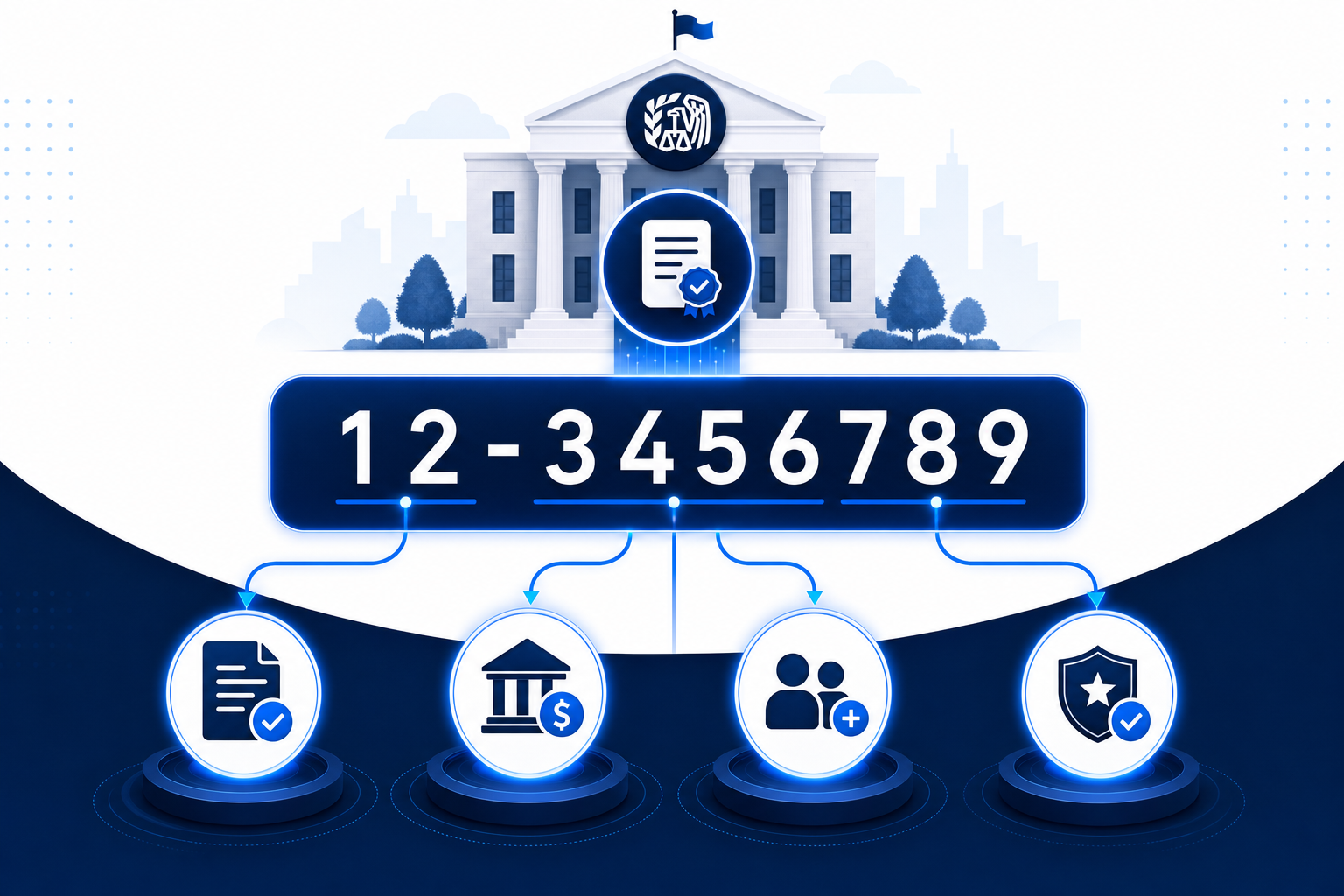
If you are starting a business, opening a US bank account, or hiring employees in the United States, you will almost certainly need an EIN. This comprehensive guide explains exactly what an EIN is, how the numbering system works, who needs one, and how to get one -- whether you are a US resident or an international entrepreneur operating from abroad.
Understanding your EIN is essential because it appears on virtually every federal tax document your business files. It is used by the IRS to track your business's tax obligations, and it is required by banks, payment processors, and other financial institutions before they will open accounts or process transactions on your behalf. Think of it as your business's Social Security Number -- a permanent identifier that follows your entity throughout its lifetime.
Definition
What Does EIN Stand For?
EIN Definition and Origin
EIN stands for Employer Identification Number. It is a federal tax identification number assigned by the Internal Revenue Service (IRS) to business entities operating in the United States. The IRS created the EIN system in 1974 to build a standardized identification system for businesses, separate from the Social Security Number (SSN) system used for individuals. The IRS issues between 4.5 million and 5.5 million new EINs per year as of 2024.
Other Names for an EIN
You will hear an EIN called by other names. The terms Federal Employer Identification Number (FEIN), Federal Tax Identification Number, and Tax ID Number (TIN) all describe the same thing. Regardless of which name is used, they all refer to the same 9-digit number issued by the IRS. For a full breakdown of why both names exist, see FEIN vs EIN.
Why the EIN System Exists
The IRS needs a reliable way to identify and track the tax obligations of millions of business entities across the country. Before the EIN system was formalized, tax administration for businesses was cumbersome and error-prone. By assigning a unique number to each entity, the IRS can efficiently process tax returns, track payments, and enforce compliance. Today, over 30 million active EINs are in use across the United States, and the IRS processed 5.1 million new EIN applications in fiscal year 2023 alone.
You Do Not Need Employees to Need an EIN
Despite the word "Employer" in the name, you do not need to have employees to need an EIN. Single-member LLCs, sole proprietors filing excise taxes, trusts, and estates all require an EIN for tax filing and banking purposes. The name is a historical artifact from 1974 when the primary use case was employer tax reporting. In 2024, fewer than 40% of new EIN applications come from entities with employees -- the majority are non-employer businesses, trusts, and estates.
Format
EIN Number Format Explained
An EIN is a 9-digit number formatted as XX-XXXXXXX. The first two digits are separated from the remaining seven by a hyphen. For example, a valid EIN looks like 12-3456789.
EIN vs SSN vs ITIN Format Comparison
| Factor | EIN | SSN | ITIN |
|---|---|---|---|
| Format | XX-XXXXXXX | XXX-XX-XXXX | 9XX-XX-XXXX |
| Total Digits | 9 | 9 | 9 |
| Hyphen Position | After digit 2 | After digits 3 and 5 | After digits 3 and 5 |
| Identifies | Business entities | US citizens and residents | Non-residents without SSN |
| Issued By | IRS | Social Security Administration | IRS |
| Expires? | Never | Never | After 3 years of non-use |
| Application Cost | $0 (IRS direct) | $0 | $0 (IRS direct) |
| Processing Time | Instant (online) or 4 days (fax) | 2-4 weeks | 6-11 weeks |
What the Digits Mean
First two digits (prefix)
Remaining seven digits (serial)
The EIN format is intentionally similar to the SSN format (which is XXX-XX-XXXX) in that both are 9-digit numbers, but they use different hyphenation patterns. This distinction helps prevent confusion between the two types of identifiers. An EIN always has the hyphen after the second digit, while an SSN has hyphens after the third and fifth digits.
For a deeper dive into valid EIN prefixes and how to verify your EIN format, refer to the IRS documentation on EIN number format.
Issuing Authority
Who Issues EIN Numbers?
EINs are issued exclusively by the Internal Revenue Service (IRS), which is a bureau of the United States Department of the Treasury. The IRS assigns EINs under Internal Revenue Code §6109, which requires taxpayers to furnish identifying numbers for tax administration purposes. No other government agency, state authority, or private organization has the authority to issue an EIN. Any service that claims to "issue" an EIN is actually filing the application with the IRS on your behalf -- the EIN itself always comes from the IRS. To apply, you submit IRS Form SS-4 (Rev. December 2023), available at irs.gov/businesses/small-businesses-self-employed/employer-id-numbers.
The IRS offers 4 methods for obtaining an EIN, depending on your circumstances:
Online (EIN Assistant)
Fax (Form SS-4)
Phone
Mail (Form SS-4)
Regardless of which method you use, the EIN is always free when obtained directly from the IRS. Be wary of websites that charge hundreds of dollars for what is fundamentally a free government service. At ein.so, we charge only $49 for our service because we are handling the SS-4 preparation and fax filing process on your behalf -- not for the EIN itself.
Comparison
EIN vs SSN vs ITIN vs TIN
The US tax system uses multiple types of identification numbers. Each serves a different purpose and is issued to a different group of people or entities. Understanding the distinctions is important because using the wrong number on a tax form or bank application can cause delays, rejections, or compliance issues.
| Feature | EIN | SSN | ITIN | TIN |
|---|---|---|---|---|
| Full Name | Employer Identification Number | Social Security Number | Individual Taxpayer Identification Number | Taxpayer Identification Number (umbrella term) |
| Digits | 9 (XX-XXXXXXX) | 9 (XXX-XX-XXXX) | 9 (9XX-XX-XXXX) | Varies by type |
| Issued To | Businesses & entities | US citizens & authorized residents | Non-residents & residents not eligible for SSN | All taxpayers (general category) |
| Issued By | IRS | Social Security Administration | IRS | IRS / SSA |
| Primary Purpose | Business tax reporting | Personal tax & social security benefits | Individual tax reporting (no work authorization) | General tax identification |
| Cost | Free | Free | Free | Free |
What Is a TIN?
A TIN (Taxpayer Identification Number) is not a specific number type -- it is an umbrella term that encompasses EINs, SSNs, ITINs, and other identification numbers used for tax purposes. When a form asks for your "TIN," you should provide whichever number is appropriate for your situation: your EIN for business-related filings, or your SSN/ITIN for individual filings.
Which Number Do You Need?
US citizens and permanent residents who operate a business need both an SSN (for personal taxes) and an EIN (for business taxes). Non-residents who form a US LLC or corporation need an EIN for the business. Non-residents who also earn US personal income need an ITIN in addition to their EIN. For more detailed comparisons, see our dedicated guide on EIN vs ITIN.
Requirements
Who Needs an EIN?
The IRS requires certain business entities and organizations to have an EIN. Even if it is not strictly required for your situation, having an EIN can be beneficial for separating your personal and business finances. Here is a comprehensive list of entities and situations that require an EIN:
Corporations
Partnerships
Multi-Member LLCs
Single-Member LLCs
Sole Proprietors with Employees
Non-Profit Organizations
Trusts & Estates
Farmers' Cooperatives
Plan Administrators
Foreign-Owned US Entities
EIN Requirements by Entity Type
| Entity Type | EIN Required? | IRS Form | Notes |
|---|---|---|---|
| C-Corporation | Yes, always | Form 1120 | Required at incorporation |
| S-Corporation | Yes, always | Form 1120-S | Must file Form 2553 for S-election |
| Multi-Member LLC | Yes, always | Form 1065 | Taxed as partnership by default |
| Single-Member LLC | Recommended | Schedule C (Form 1040) | Required if LLC has employees or files excise taxes |
| Partnership (GP, LP, LLP) | Yes, always | Form 1065 | Each partner receives Schedule K-1 |
| Nonprofit (501(c)(3)) | Yes, always | Form 990 | Required before filing Form 1023 |
| Irrevocable Trust | Yes, always | Form 1041 | Separate tax entity from grantor |
| Estate | Yes, always | Form 706 / 1041 | Executor must apply after decedent's death |
| Sole Proprietor (with employees) | Yes, always | Form 941 / 940 | Required for payroll tax reporting |
| Sole Proprietor (no employees) | Recommended | Schedule C (Form 1040) | Protects SSN; required by most banks |
| Foreign-Owned US LLC | Yes, always | Form 5472 + pro-forma 1120 | $25,000 penalty per year for non-filing |
Why Banks and Payment Processors Require an EIN
Even if you are a sole proprietor without employees, many banks require an EIN to open a business bank account. Payment processors like Stripe and PayPal also require an EIN when setting up business accounts. Chase, Bank of America, Wells Fargo, Mercury, and Relay all mandate an EIN for business account opening. Having an EIN helps establish your business as a separate entity and protects your SSN from being shared on business documents.
For a complete breakdown of every situation that requires an EIN, see our Who Needs an EIN? guide. An EIN is also often confused with a business license — see EIN vs business license for why they are different documents — with a DBA trade name, covered in EIN vs DBA, or with an industry classification code in EIN vs NAICS code.
Application Process
How to Get an EIN
The process for obtaining an EIN depends on whether you are a US resident with a Social Security Number (SSN) or Individual Taxpayer Identification Number (ITIN), or a non-US resident without either. Both paths ultimately result in the same 9-digit EIN, but the application methods differ significantly.
For US Residents (with SSN or ITIN):
- Visit the IRS EIN Assistant at irs.gov
- Select your entity type (LLC, corporation, sole proprietor, etc.)
- Enter your personal information including your SSN or ITIN
- Provide your business details (name, address, type of activity)
- Submit the application and receive your EIN immediately
The online application is available Monday through Friday, 7:00 AM to 10:00 PM Eastern Time.
For Non-US Residents (without SSN or ITIN):
- Complete IRS Form SS-4 (Application for Employer Identification Number)
- Fax the completed form to the IRS at 855-215-1627
- Wait about 4 business days for processing
- Receive your EIN via fax from the IRS
Alternatively, you can call the IRS at 267-941-1099 to apply by phone during business hours.
Getting the SS-4 form right is critical. Common errors -- such as selecting the wrong entity type, entering an incorrect address format, or leaving required fields blank -- can result in the IRS rejecting your application, which means starting the process over and waiting another week or more. This is one of the main reasons non-residents choose to use a service like ein.so to handle the filing.
For a complete step-by-step walkthrough of the application process, see our how to get an EIN guide.
Non-Residents
Can Non-Residents Get an EIN?
Yes, absolutely. Non-US residents can and do obtain EINs from the IRS. In fact, if you are a foreign person or entity that has US tax obligations -- such as owning a US-based LLC, investing in US real estate, or earning income from US sources -- you are required to have an EIN.
The challenge for non-residents is that the IRS online EIN application (the EIN Assistant) requires an SSN or ITIN to verify the applicant's identity. If you do not have either of these numbers, you cannot use the online system. This leaves two options:
Option 1: File Form SS-4 by Fax
Complete Form SS-4 and fax it to the IRS at 855-215-1627. This is the most common method for non-residents. Processing takes about 4 business days, after which the IRS will fax back your EIN assignment letter. The form must be filled out correctly, as errors will result in rejection and delays.
Option 2: Call the IRS International Line
Call 267-941-1099 during IRS business hours (Monday-Friday, 6:00 AM - 11:00 PM Eastern Time). Be prepared for potentially long wait times, especially during peak periods. The IRS agent will walk through the SS-4 questions over the phone and can issue your EIN during the call.
How ein.so Helps
We handle the entire SS-4 filing process for non-residents. You provide your information, we prepare and fax the form to the IRS, and we deliver your EIN by email. Our Standard service is $49 (12-15 business days) and our Express service is $97 (8-10 business days). Subject to delay due to IRS processing time. No SSN required, no navigating IRS phone trees, no fax machine needed.
For more information about the non-resident EIN process, visit our How to Get an EIN guide.
Deep Dive
EIN Format Details
How to Validate an EIN
A valid EIN must satisfy 3 criteria: it must be exactly 9 digits, the first two digits (the prefix) must fall within a range that the IRS has assigned, and it must follow the XX-XXXXXXX formatting convention. Understanding these rules helps you verify that an EIN is valid and identify potential errors before submitting it on tax forms or bank applications.
EIN Prefix Ranges and History
The IRS has used a specific set of two-digit prefixes over the years. Prefixes 10-16 were assigned by the Andover campus, 20-27 by Austin, 30-39 by Cincinnati, 40-48 by Kansas City, 50-59 by Philadelphia, 60-68 by Atlanta, and 80-88 by the internet-based assignment system introduced in 2001. Prefixes starting with 20, 26, 27, 45, 46, and 47 are among those assigned to more recent internet-based applications. If you see an EIN with a prefix that does not match any known IRS campus or assignment method, it may be invalid.
Where Your EIN Appears
Your EIN will appear on multiple important documents, including your IRS confirmation letter (CP 575), your annual tax returns (Form 1120 for corporations, Form 1065 for partnerships, Schedule C for sole proprietors), W-2 and 1099 forms you issue to employees and contractors, and any correspondence you receive from the IRS. Double-check that your EIN is correctly formatted on these documents to avoid processing delays.
Do EINs Expire?
EINs do not expire. Once the IRS assigns an EIN to your entity, that number is permanently yours. However, the IRS will deactivate an EIN if it has not been used on any federal tax filing for 3 or more consecutive years. A deactivated EIN is not deleted -- it can be reactivated by contacting the IRS at 800-829-4933 and filing the appropriate returns. The EIN is never reassigned to another entity, even after deactivation.
For a comprehensive reference on valid prefixes and format validation, refer to the IRS documentation on EIN number format.
Summary
Key Takeaways
Key Takeaways
- An EIN (Employer Identification Number) is a 9-digit number in the format XX-XXXXXXX, issued by the IRS to identify business entities.
- EINs are also called FEIN, Federal Tax ID, or Tax Identification Number.
- Only the IRS issues EINs. They are always free when obtained directly from the IRS.
- US residents with an SSN/ITIN can apply online for free and receive their EIN immediately.
- Non-residents must use Form SS-4 by fax (855-215-1627) or phone (267-941-1099).
- EINs do not expire, but can be deactivated after 3+ years of non-use on federal filings.
- Corporations, partnerships, LLCs, non-profits, trusts, estates, and sole proprietors with employees all need an EIN.
Related definitions: EIN number format | Federal tax ID | Tax ID lookup | EIN vs state tax ID.
Frequently Asked Questions
Is an EIN the same as a Tax ID number?
An EIN is one type of Tax Identification Number (TIN). The term 'Tax ID' is a broad category that also includes Social Security Numbers (SSNs) and Individual Taxpayer Identification Numbers (ITINs). When people refer to a 'business Tax ID,' they almost always mean an EIN.
How much does it cost to get an EIN?
Applying for an EIN directly through the IRS is completely free. However, the IRS online application requires a US-based SSN or ITIN. Non-US residents who cannot use the online system often use a third-party service like ein.so to handle the SS-4 fax filing process.
Can a non-US resident get an EIN?
Yes. Non-US residents can obtain an EIN by submitting Form SS-4 to the IRS by fax (855-215-1627) or by calling the IRS at 267-941-1099. The IRS online EIN application is not available to applicants without an SSN or ITIN. ein.so handles this process for $49.
Do EIN numbers expire?
EINs do not technically expire. Once issued, your EIN is permanently assigned to your entity. However, the IRS may deactivate an EIN if it has not been used on any federal tax return or other IRS filing for three or more consecutive years. A deactivated EIN can sometimes be reactivated by contacting the IRS.
How long does it take to get an EIN?
If you apply online through the IRS (US residents with an SSN/ITIN only), you receive your EIN immediately. For fax applications using Form SS-4, the IRS processes and returns your EIN within about 4 business days. Phone applications through the IRS international line may be processed during the call itself.
Can I apply for an EIN online without an SSN?
No. The IRS online EIN application (the EIN Assistant) requires a valid SSN or ITIN. If you do not have either, you must apply using Form SS-4 submitted by fax or mail, or by calling the IRS international line at 267-941-1099.
What is the difference between an EIN and an SSN?
An SSN (Social Security Number) is a 9-digit number assigned to US citizens and authorized residents for personal tax and social security purposes. An EIN (Employer Identification Number) is a 9-digit number assigned to businesses and other entities for federal tax identification. An SSN identifies individuals; an EIN identifies businesses.
Need an EIN? We Handle Everything.
Non-US resident? We file Form SS-4 with the IRS and deliver your EIN by email. Just $49.
Get My EIN for $49Express - $978-10 business daysSubject to delay due to IRS processing time.